01
Matter Lookup
Pull relevant matter details from approved exported data.
Your AI employee prepares discovery drafts, deposition outlines, provider chronologies, matter briefs, and client emails using only the files and systems you authorize.
Every output waits for attorney review. You decide what is revised, approved, sent, or filed.
Personal reply within one business day. No client names or case details needed.

Attorney-directed workflow
You assign. Lloyd prepares. You review.
Legal judgment and final approval stay with the attorney.
| Work | Without help | With an AI employee |
|---|---|---|
| Matter preparation | Reconstruct the file before a call | Review a source-linked matter brief |
| Discovery | Draft every request from scratch | Edit a prepared first draft |
| Medical record review | Build the provider timeline by hand | Review a chronology with record gaps flagged |
| Client updates | Recheck the file before every response | Review a drafted status update |
Illustrative example
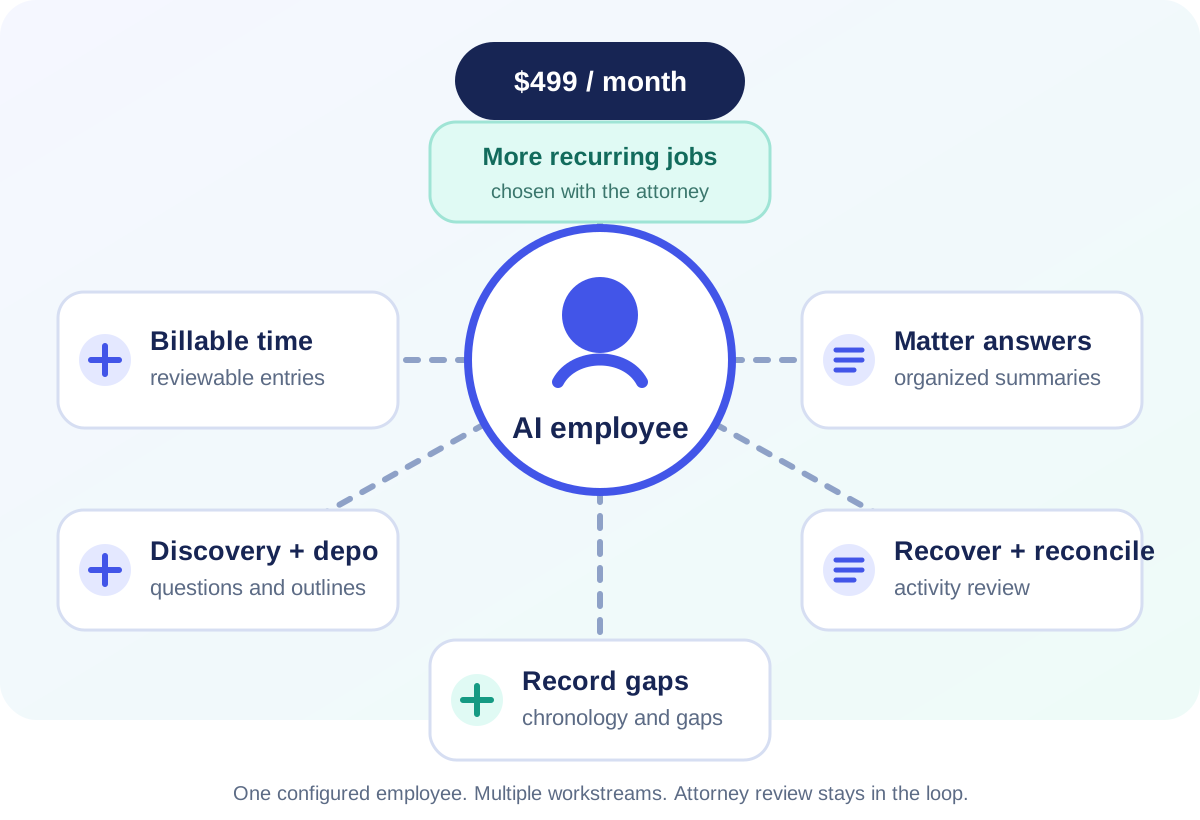
These capabilities prepare work for attorney review. They do not send, file, or write to a practice-management database on their own.
Pull relevant matter details from approved exported data.
Draft a clear summary of disbursements for your review.
Prepare email drafts that wait for your approval before sending.
Create note text for manual paste, with no direct database writes.
Identify missing information in medical records for your review.
Generate initial discovery questions and deposition outlines.
Every firm is configured separately, and these examples do not promise compatibility with your current systems.
This internal legal AI employee prototype uses fictional data and has not been deployed for a client.
Combines Dialpad, Outlook, PLAUD, and Clio evidence to identify possible unrecorded work without treating scheduled time as billable time.
Groups evidence by day and matter, flagging overlaps, incomplete source coverage, and unresolved matters.
Prepares records locally for review of matter, minutes, description, and warnings before approval or dismissal; approvals do not write time entries into Clio.
Each morning, I open a review queue containing website improvements, campaign drafts, client reports, and opportunities my AI employees prepared overnight. I review the work, make decisions, and approve what moves forward. Nothing reaches a client or gets published without me.
The work is different in a law firm. The operating model is the same: the AI employee prepares, the professional reviews, and the human decides.
Built means we have already created that capability. Potential means it must be scoped for your practice, software, and review process.
Focus on the client, not the paperwork.
Keep every claim moving forward.
Give clients clarity during a difficult time.
Help families settle matters with less stress.
Stay ahead of deadlines and documentation.
A controlled implementation built around your practice, your systems, and your review process.
We identify your practice area, software, source material, and required work product before recommending a setup.
We select the relevant parts of Matter Answer Desk, Medical Record Gap Finder, and Billable Time Recovery. Not every capability fits every firm.
We install it on your computer and business account during an attended session. No permanent remote-access software is left behind.
Work enters a local review process. Nothing is sent or written to your practice-management database automatically.
You keep the AI employee and written operating instructions. Continued development is optional.
The Value Ledger keeps the human review visible.
It records what the AI produced and what a human reviewed, approved, or rejected. It is an accountability record, not a compliance certificate.
Optional continued development
$499 per month
Start with the job you want off your plate. Your software may already offer a connection we can use, or the job may need a custom setup. Here are three possibilities worth checking.
Prepare a matter brief before a client call.
Clio documents custom connections for a single firm. I would check your plan, permissions and the records needed for your brief first. EasyStart does not include integrations.
Ask for a case summary or upcoming tasks.
MyCase offers a read-only connection to Claude on Team or Enterprise plans. It retrieves information but does not change records. We would start by checking whether that existing connection covers your job.
Find case information and prepare a source-linked summary.
MerusCase documents a custom connection route for one firm. The next check is whether your user permissions and available records cover the job.
These are documented possibilities, not integrations I have tested for your firm. Any software connection is scoped and quoted separately. Your plan and the exact task determine what is possible.
Use something else? Tell me its name. A first job may be possible with documents you choose to provide while we check the software connection.
Tell me your software and first job
I build your AI employee, configure it around your practice and software, and install it with you present. I have used AI daily for two years, set it up in more than 15 businesses, built more than 10 automations, and taught AI weekly to business owners for a year and a half.
Choose the model closest to your practice and change the assumptions. The calculator shows the scenario you enter, not a promised result.
Time redirected to clients and legal judgment
Planning scenario only. Your entries are not sent or stored. Results are mathematical illustrations, not savings, revenue, or performance guarantees.
One implementation includes three defined legal workflows, delivered one at a time, plus the configuration and review documentation.
Founding rate: $2,999, 4 spots remaining.
Built around your practice and installed during an attended session. The first workflow includes 45 days of adjustments. Workflows two and three are scheduled when you are ready.
Optional continued development is $499 per month. It is not required to keep using your AI employee.
See What It Could Handle at My FirmWe will first confirm that the work and your current software make this a sensible fit.
It prepares work that stacks up between hearings. It can support Billable Time Recovery, Matter Answer Desk, and Medical Record Gap Finder. Every piece comes to you as draft support for review. It does not decide legal questions or replace attorney judgment.
Your AI employee runs on your own business account under commercial terms where your data is never used to train AI models, and your files stay on your machine. The AI reads material only through your own business-tier account, never through free consumer tools. For law, I set it up to meet the State Bar of California's Practical Guidance for the Use of Generative Artificial Intelligence in the Practice of Law, and leave you a written one-pager on exactly how it is configured.
No. It drafts and you decide. Nothing is sent, filed, or published until you review and approve it. That boundary is deliberate: the judgment stays with the attorney, and the AI employee takes the hours of assembly work in front of that judgment.
It depends on your software, subscription and the job. Some systems offer an existing connection; others need custom setup or vendor approval. I check the required information and actions before proposing a connection, which is scoped and quoted separately. You can also start with documents you choose to provide.
No. You talk to your AI employee in plain English, the same way you would brief a person. I build it, train it on your practice before you meet it, install it at your desk, and work through real files with you until you are comfortable. If you can send an email, you can run an AI employee.
Installed in your office is $4,999, with a founding rate of $2,999, 4 spots remaining. Adding new capabilities later is an optional $499 a month. Compare it to a hire: a part-time admin runs $1,500 to $2,500 every month.
Prepare three short notes for your first conversation with Wesley. They help define the work before discussing a setup.
Name one recurring task and the draft you want to review. Include your practice area and how the work is billed, so the conversation starts with what matters to your firm.
List your practice-management software and the features you already use for that job. The first question is whether your existing tools cover it.
Identify the attorney who would check the draft and approve any next step. An AI employee prepares work under human review.
Use the inquiry form to share your contact details. Keep these notes for Wesley's reply. A general description is enough; leave out client names, case details and documents.
Prefer to talk? Call or text (916) 794-7877. I answer.
Please do not include client names or case details. See our privacy policy for how your information is stored and used.